Whitechapel Gallery, London, 3 February 2025
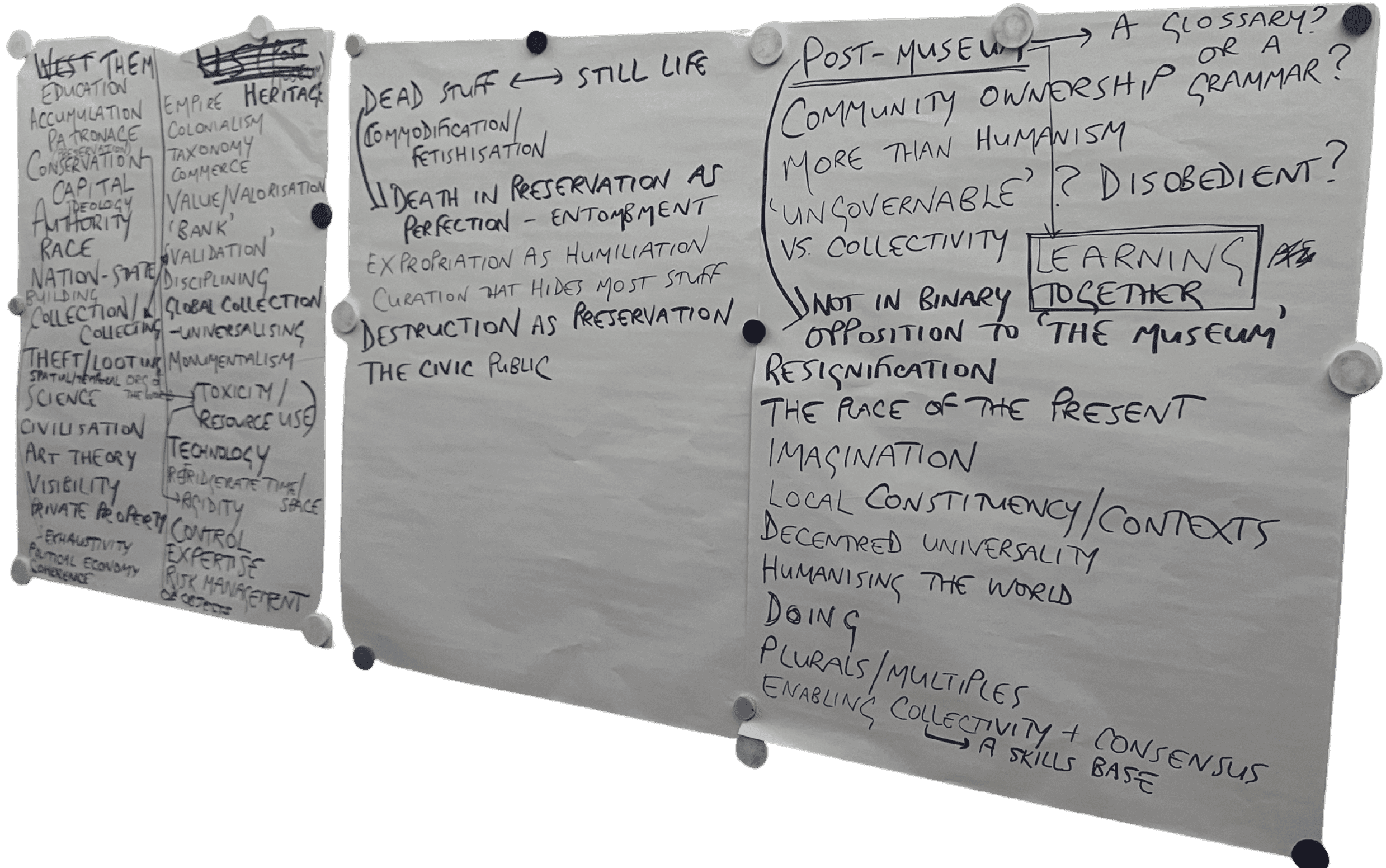
During the first instantiation of Imagining the Post-Museum, a preliminary meeting that took place at the Whitechapel Gallery in February 2025 with partner institutions, a key words exercise emerged during the conversation. What characterises the imperial museum? We asked. And what, ideally, would characterise the post-museum? We found it much easier to identify that which we opposed in the existing museum space. Once we entered the territory of speculative thinking, it became harder to describe things concretely. This lack of concrete thinking gave way to the first collective workshop, in which we decided to build things. Below is a list of the defining terms generated, as well as a snippet of the conversation that ensued once the list for the post-museum broke down.
Imperial museum
- Accumulation
- Patriarchy
- Private property
- Conservation
- Theft
- Looting
- Exhaustivity
- Science
- Art theory
- Art history
- The artistic canon
- Race
- Culture
- Culture against nature
- Civilization
- Education
- Money
- Narrative
- Consumption
- Power
- Coloniality
- Ideology
- Mastery
- Coherence
- Hegemony
- Division of the world
- Taxonomy
- Commerce
- Valorisation
- Validity
- Globality
- Technology
- Preservation
- Toxicity
- Standard Setting
- Control
- Risk management
- Heritage
- Objects
- Commodification
- Fetishization
- Entombement
post museum
- Community
- More-than-humanism
- Learning
- Un-learning
- Solidarity
- Locality
- Situated universality
- Humanisation of the world
- Dissensus
- Caring
- Carrying
- Ungovernable?…
Some of these are difficult to define, what do they mean concretely? Who do you disobey? how? why? Does this still mean we’re defined by the oppressor? If we want to be community based or connected, disobedience isn’t always a possibility. How do you work in communities? how do you work with groups, in ways that are horizontal and also how do you put in mechanisms which don’t reproduce systems of hierarchy that we are all used to working in, how do you prevent systems like power being entrenched or centralizing to people. This in fact pertains to governance. We must work out this relation and try to build something that will effectively, that conflict will not overwhelm, but conflict will be accepting nonetheless. We need to address our ghosts in the post-museum